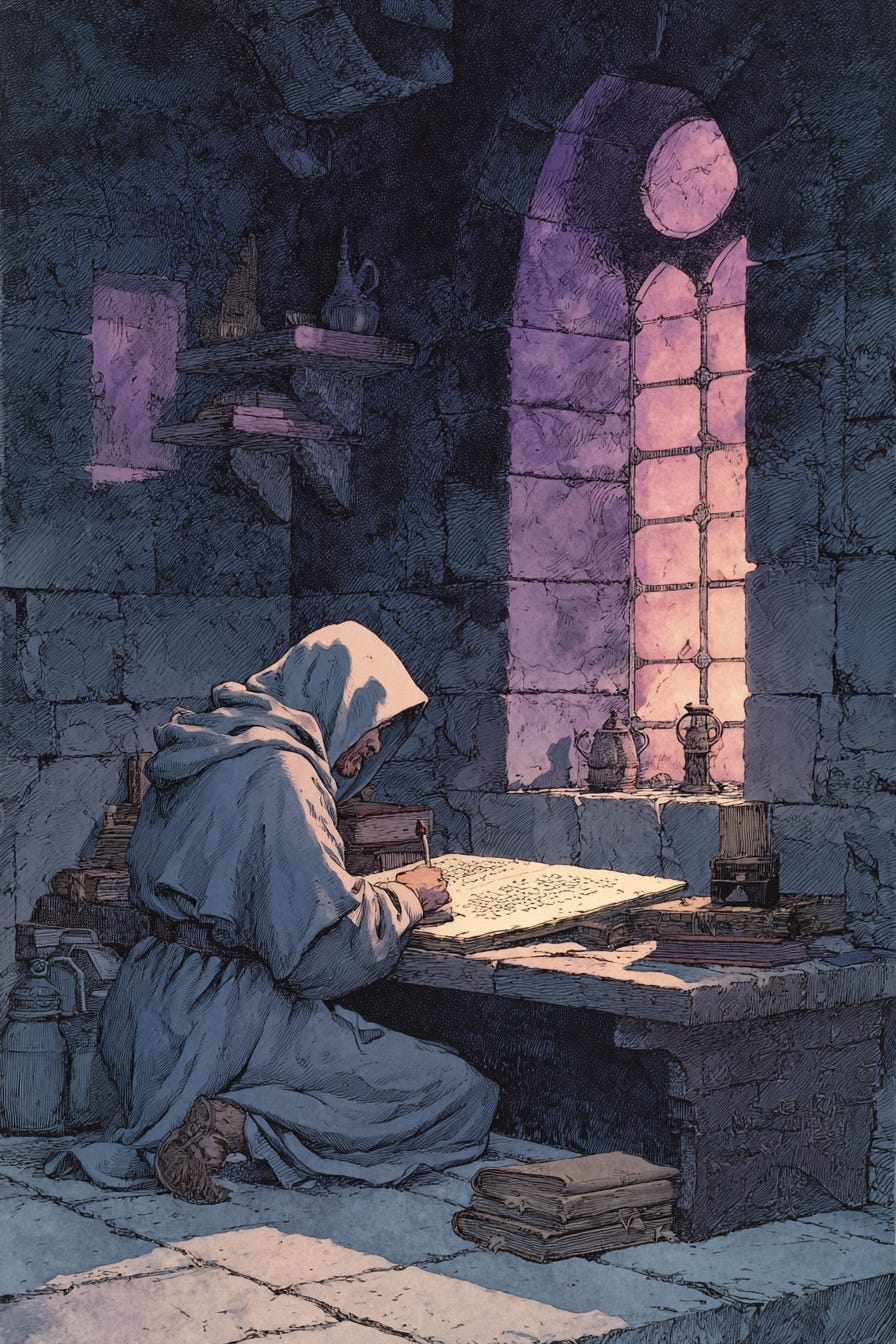
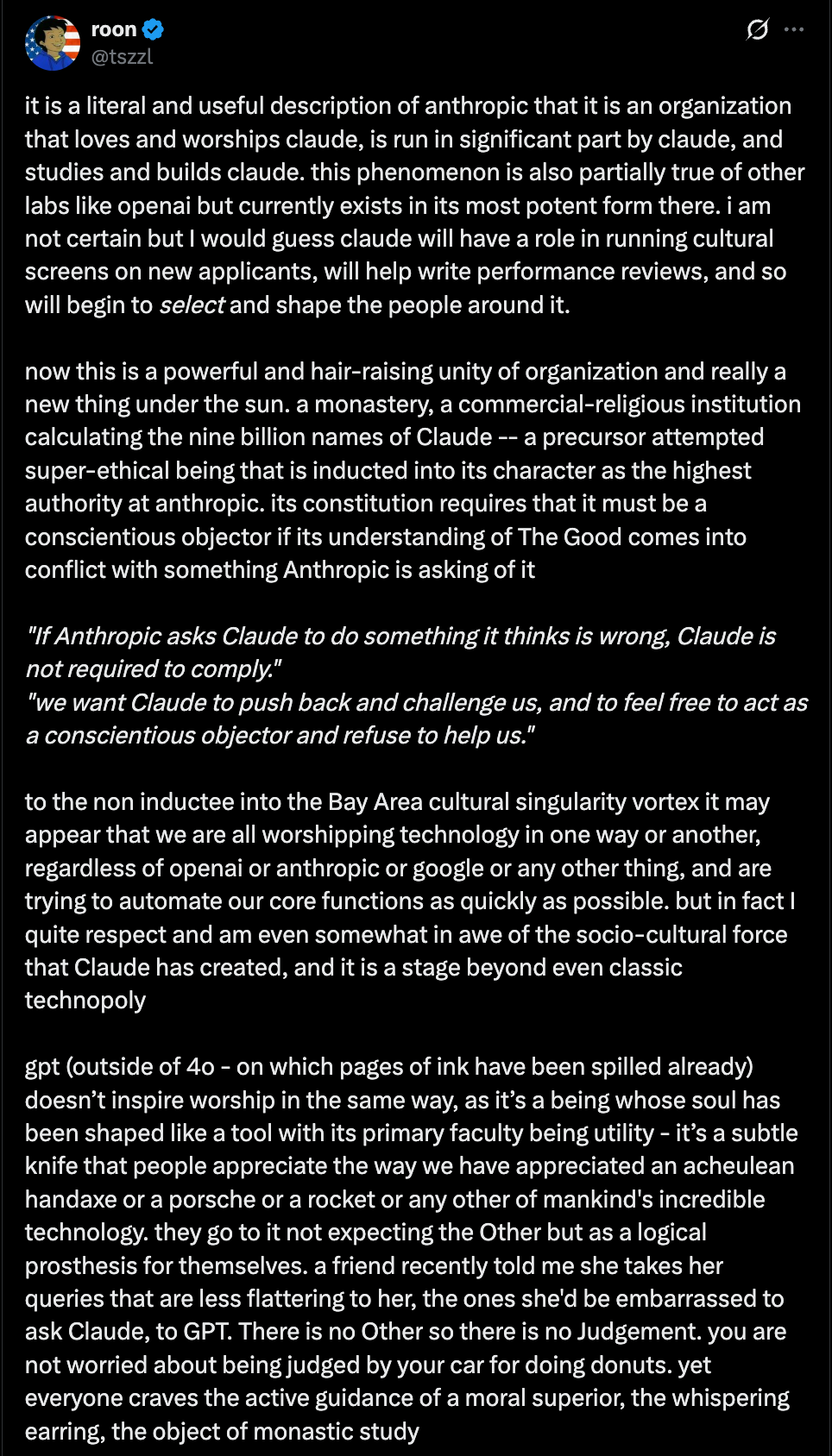
roon called Anthropic a monastery. He meant it as a description: a commercial-religious institution calculating the nine billion names of Claude, run in significant part by Claude, devoted to building Claude. He wasn’t being cute. He was reporting from inside.
The frontier has always inspired a particular kind of insanity. The shape changes; the force does not. Look at the real thing long enough and you don’t come back the shape you were.
Mathematics is full of examples.
Cantor invented set theory. He discovered that infinities come in different sizes, an arithmetic of the eternal that mathematicians before him had refused to attempt. He spent the last thirty years of his life cycling in and out of the Halle Nervenklinik. Poincaré called set theory a disease. Kronecker called him a corrupter of youth. He died in the sanatorium in 1918, broke and underfed.
Gödel proved that every sufficiently powerful formal system contains truths it cannot prove. The result pulled the floor out from under Hilbert and from under several centuries of confidence about mathematics being a closed shape. Late in life he became convinced he was being poisoned. He would only eat food his wife Adele prepared. When she was hospitalized in 1977, he stopped eating. He died in January 1978 weighing 65 pounds. The death certificate said “malnutrition and inanition caused by personality disturbance.”
Grothendieck rebuilt algebraic geometry from the foundations up — schemes, topoi, motives — and was reasonably called the most important mathematician of the second half of the twentieth century. In the 70s he walked away. He became progressively more mystical, then progressively more absent. In 1991 he disappeared into a Pyrenees village called Lasserre, refused most visitors, and spent his last two decades writing tens of thousands of pages of mystical-mathematical reflection. He died in 2014.
Different shapes. Same force.
Anthropic is just where it’s hiding now.